/ 00 Point B — a strategic clarity and positioning sprint for B2B companies

Your company
is worth more than
it shows.

Point B is a two-week sprint for founders of B2B companies that have grown, while their message, positioning and marketing haven’t kept up.

You bring the business, the ambition and the decisions on your mind. I run the process. You leave with a map from A to B and a filter for deciding what to do, what to postpone and what to say no to.

The conversation is free and it isn’t a sales pitch. If your problem isn’t about direction, I’ll tell you.
Duration
2 weeks+ 14 days of questions
Workshop
One day, onlinewith your leadership team
You leave with
Map + Filterand the brief, as PDF
Investment
€1,950first 5 companies: €1,500
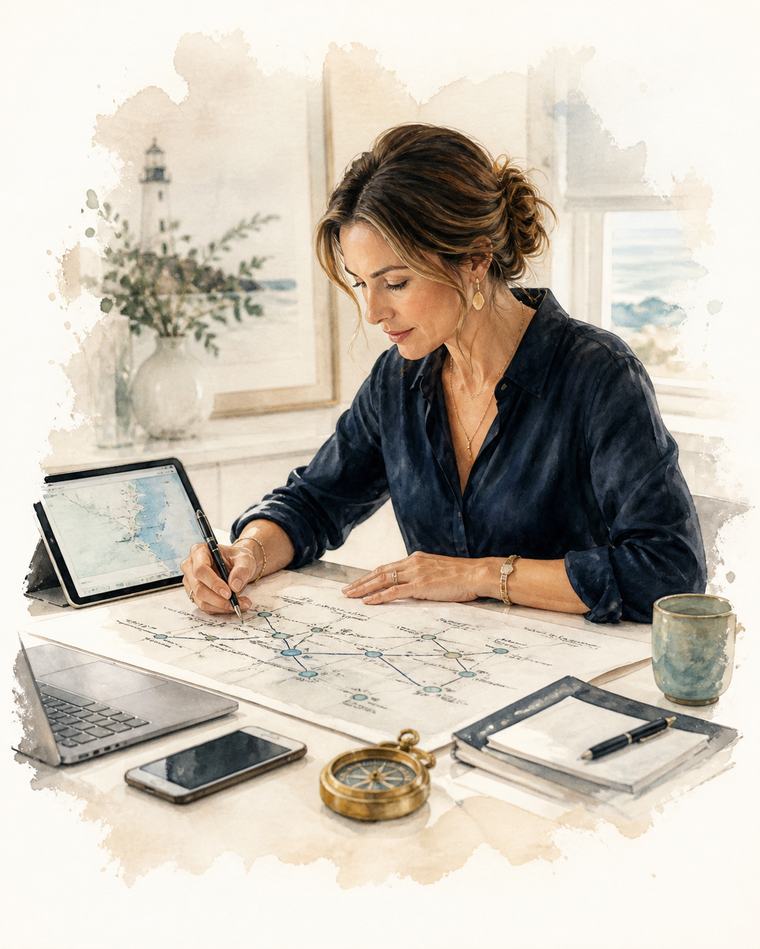
La Far watercolour: a woman drawing a map of routes, next to a compass and a laptop.
The A → B Map
and the Point B Filter
Two tools you’ll use for years, not a report that ends up in a drawer.

Point B at a glance

Who it is for
Founders and leadership teams of B2B companies whose message, positioning and marketing have not kept up with their growth.
What we clarify
Who you are, who you serve, what makes you different and which priorities move you towards the next stage.
Who you work with
Cristina Ionescu-Taifas personally leads Point B, the English name of La Far’s Punctul B service. Explore Cristina’s background.
Duration and format
Two weeks, including one online workshop day, followed by 14 days of email questions after the final deliverables. In-person sessions in Bucharest are available on request.
What you receive
The A → B Map, the Point B Filter and a written brief. See the deliverables and illustrative example.
Investment
€1,950 standard price; €1,500 for the first five companies in exchange for an honest testimonial and permission to be named as a reference. See the first-series terms.
Point A —
/ 01 Why Point B exists

I went into corporations looking for secrets.
I found three questions.

Twenty years — Deutsche Telekom, Alpha Bank, Western Union and many other rooms where people decided what a brand means to millions.

I expected formulas. Sophisticated models. People who knew something the rest of the market didn’t.

I found the same three questions, asked obsessively. And I saw that the companies that take them seriously can’t afford the luxury of confusion. Maybe that’s exactly why they became big.

In recent years I’ve sat more and more often on the other side of the table, next to entrepreneurial companies. Good products. Serious teams. Founders who have built something real. And, often, a gap that’s hard to explain between what the company is worth on the inside and what shows from the outside.

  1. 01Who are we?
  2. 02Who do we exist for?
  3. 03What do we say no to?

Not bureaucracy. Respect for your own identity.

I believe a good company loses because its value
can’t be seen from a distance.
And that is fixed with a decision about direction.
That’s where Point B begins
/ 02 The seven moments test

When you need strategic clarity.

I wrote about them one by one on LinkedIn. Here you can tick the ones you recognise. The result appears instantly and nobody sees it but you.

0/7

Tick the moments you recognise.

The result changes with every tick. I’ll tell you honestly what I think, including if you don’t need Point B.

They look like seven different problems. They aren’t. They’re just the places where the same problem finally becomes visible: a decision about direction that was postponed, not made.

The one-page test

Could you write, yourself, on a single page: who you are, who you exist for, what makes you different and where you want to be in two years? If yes, you already have a Point B. Use it. If not, that’s where we start.

Why now

For many companies, autumn is when the 2027 budgets get decided: website, agency, campaigns, hiring. Point B comes before all of them, so the money buys execution, not assumptions.

/ 03 How we work

How the Point B sprint works.

You bring the reality of the business and the decisions that matter. I run the process, ask the uncomfortable questions and write down clearly what we’ve decided together.

  1. / 01

    The conversation

    30 minutes, free

    You: tell me what the company does, what stage comes next and which decision is on your mind.

    Me: I tell you honestly whether it’s a direction problem. If it’s an execution problem, I’ll tell you that too and, if I can, recommend someone.

  2. / 02

    The preparation

    about 20 minutes of your time

    You: fill in the preparation form. Honestly, including “I don’t know” where that’s the case.

    Me: I study your brand, market and competitors, and build the working board for your company, not from a template.

  3. / 03

    The workshop

    one day, online

    You: bring your leadership team. The person who decides stays all day.

    Me: I run the process. We build the map live, together, and note separately what remains undecided.

  4. / 04

    The deliverables

    presentation call 5 days after the workshop

    Me: I write the Map, the Filter and the brief.

    Together: we go through them on the call, with one round of feedback included. Then you receive the final versions.

  5. / 05

    The 14 days

    after the final deliverables

    You: start using them in real decisions.

    Me: I stay available by email for questions and decisions.

Your time, in total: ~20 minutes of preparation one workshop day the presentation call Online, on a collaborative whiteboard and video. In Bucharest, in person is also possible on request.
— Point B
/ 04 What you get

What you receive:
the Map, the Filter and the brief.

  • Tool 1The A → B MapWhere the company is today. Where it wants to go. What has to change between the two points. On a single page, plus a wall version, in PNG and PDF.
  • Tool 2The Point B FilterFive questions you run every big decision through: campaign, offer, new market, hire. They show you whether it brings you closer to B or just keeps you busy.
  • After the sprint14 days of supportOnce Point B is over, I stay available by email for two weeks, for whatever comes up while you put the decisions into practice.

What they look likeA demo example, on a fictional company: an IT supplier that wants to become the partner of manufacturing firms.

The A → B MapDemo example
Point A · today
A trusted IT supplier for SMEs, chosen through referrals.
Point B · in two years
The partner manufacturers call when they move their operations to the cloud.
The client we grow for
Operations directors at companies of 200–1,000 people.
Who we’re compared with
The big integrators: “safe, but slow”.
The difference we claim
A senior team on every project, no subcontracting.
The core message
Migration without stopping production.
Three directions
  1. Case studies from manufacturing.
  2. A “migration audit” offer.
  3. No more tenders decided on price alone.
The Point B FilterDemo example
The decision on the tableDo we open an office in another country in 2027?Estimated budget: €180,000
  • Does it bring us closer to Point B?PartlyThe manufacturers are there too. But the reputation that brings us clients today stops at the border.
  • For whom, exactly?UnclearWe don’t yet know who decides on migration in a manufacturer there, or what they decide on.
  • What does it cost us, besides money?9 monthsThe senior team’s time. Exactly the people who deliver the projects we have now.
  • What do we say no to, to make room for it?Case studiesDirection number 1 on the map. The one that brings clients now.
  • Does it get us to B faster than the alternative?NoThe same money, put into case studies and the audit offer, gets us closer to B in 2027.
Not now. We come back to it in Q3 2027.That market stays on the map, but after the first three case studies. We enter cheaper, and with something to show.
What changes afterwards

You leave with clarity, direction and tools, so you can make the decisions that take you to Point B as efficiently as possible.

  • Briefs for your website, agency or campaigns start from a shared reference point.
  • Your team explains more consistently who you are and why you deserve to be chosen.
  • Less waste on messages and directions that contradict each other.
  • You come across more coherently to the clients you’re going after.
  • You lay the groundwork for getting out of comparisons made on price alone.
Black-and-white portrait: Cristina Ionescu-Taifas in a blazer, smiling.
/ 05 Who runs the process

For more than 20 years I sat in the meeting rooms
where future suppliers get chosen.

I’m Cristina Ionescu-Taifas. Through La Far, I work directly with founders and leadership teams. In Point B, I personally lead the process of clarifying your direction and positioning.

In those rooms, the first cut often happens before a company even gets through the door. I’ve seen a “have we heard of them?” and a shrug move a contract.

I also know what it’s like to be on the side that pitches. I won the pitch for the Deutsche Telekom centre in Timișoara: an investment of millions of euros and around 800 jobs.

With me, you’re not hiring an agency with five departments. You work directly with me, from the first conversation to the last question. I won’t tell you which colour to pick. I’ll help you decide where you want to go, and leave you the filter for choosing the route.

20+years in brand, communications and transformation
+500%growth in brand KPIs, over 7 years
98%eNPS, team engagement
~800jobs, the DT centre in Timișoara
3marketing and communications departments built from scratch
1person you talk to, from start to finish

What I can’t show you yet.

Point B is new. I don’t have case studies with it yet, and I won’t invent one. I have twenty years of doing this inside large companies and a process written down step by step. That’s why the first five companies come in on first-series terms, set out openly below: the same deliverables, a lower price, in exchange for an honest testimonial.

/ 06 Investment

One price. Written here, not after three calls.

First series · first 5 companies

€1,500

final price

Same sprint, same deliverables. In return, I ask for an honest testimonial after the project and your consent to be named as a reference.

5 of 5 places available
Standard

€1,950

final price

Once the five first-series places are taken. Same process, same attention.

  • The 30-minute conversation
  • The preparation form and an analysis of your brand, your market and 3 competitors
  • One online workshop day, with you and your leadership team
  • The A → B Map, plus the wall version (PNG and PDF)
  • The Point B Filter
  • The Point B Brief (PDF)
  • Presentation call, with one round of feedback
  • 14 days of questions by email

Contract and payment

Contract and invoice from my sole trader entity (PFA). I am not VAT registered, so the price on the page is the final one: nothing is added on top. Payment is made by bank transfer, and as soon as it arrives I come back with the next steps and we set the workshop date.

You don’t pay twice

If we continue with Brand OS within the next 90 days, the full amount paid for Point B is deducted from the next stage.

How many companies

Two a month at most, so each one gets the attention the process needs. The five first-series places cover October–December 2026.

Book a 30-minute conversation

No artificial urgency. When a place is taken, I update it here.

/ 07 What’s next, if you want it

Point B is the decision about direction.
Brand OS is how you carry it into the market.

The same territory, at three depths. Each stage starts from what the previous one decided: we don’t reopen what’s settled and you don’t pay twice.

  1. Stage 1 you are here

    Punctul B

    You decide the direction.

    Duration
    2 weeks, with one workshop day
    You leave with
    The A → B Map, the Point B Filter and the written brief.
    Who executes
    You, with your team or your agency.
    Investment
    €1,950€1,500 for the first 5 companies · two weeks of work
  2. Stage 2

    Brand OS Light

    You turn the direction into a plan.

    Duration
    3–4 months, as a project
    You leave with
    The opportunity map (where we play and how we win), the 100-day plan with who, what and when, plus a brand book: voice, messages, visual brief.
    Who executes
    Your team or your agency, following a written plan.
    Investment
    €7,500
  3. Stage 3

    Brand OS Full

    We build and run it together.

    Duration
    12 months minimum, as a fractional CMO
    You leave with
    Everything in Light, plus the full identity, activation (funnel, campaigns, content calendar), the culture and people side, and governance: budgets, indicators, reporting.
    Who executes
    Your team, the agencies you already work with and your collaborators, on the budgets you set. I coordinate them, like an in-house CMO, in line with the strategy, the budget and the timelines we agree. I don’t bring my own suppliers. I stay the person who makes sure what we decided actually gets done, and who adjusts along the way when reality asks for it.
    Investment
    €4,500 / month1–2 days a week, like a team member who comes in on certain days. The rest of the time, a phone call or an email away.

You don’t pay twice and we don’t redo the same work. If we start Brand OS within 90 days of Point B, the Point B investment is deducted in full from the next stage. The same goes from Light to Full: we start where Light ended, with the direction and the plan already written. We don’t reopen them and you don’t pay for them a second time. If you don’t continue, you keep the map, the filter and the brief. They’re yours.
/ 08 Honestly

Who it’s for. And who it isn’t for.

It’s for you if…

  • You actively run a B2B company that has grown through reputation and referrals.
  • You feel the company is worth more than it shows from the outside.
  • A big decision is coming: website, agency, premium offer, new market, hiring.
  • You want you and your leadership team to decide against the same reference point.

It’s not the right time if…

  • You’re still at the idea or early validation stage.
  • You’re looking for a logo, posts or a campaign, without decisions about direction.
  • You need an execution agency, not a strategic intervention.
  • You don’t want to choose a direction and say no to something.
/ 09 Before you ask

What founders ask me
before we start.

/ 01Is it a workshop?
The workshop is the foundation of the sprint, but not the whole product. Point B means preparation, a day of live work, the deliverables I write, the presentation call and 14 days of questions.
/ 02How much of my time does it take?
About 20 minutes for the preparation form, one workshop day and the presentation call. The analysis and the writing of the deliverables are my part.
/ 03Who takes part in the workshop?
You and your leadership team. We agree the number of participants in the proposal. One condition: the person who decides stays all day. Without them, the map stays on paper.
/ 04I already have a website and a logo. Does it still make sense?
Yes, if you feel they no longer say who you’ve become. Point B doesn’t replace what you have. It clarifies the direction that should sit underneath your website, presentations, campaigns and recruitment.
/ 05How is Point B different from a marketing agency?
Point B clarifies the direction, positioning and priorities that guide execution. An agency can turn that direction into a website, visual identity, content or campaigns, depending on its services. You leave the sprint with the Map, the Filter and the written brief; your team or agency handles execution. If your direction is already clear and you only need implementation, you can go straight to an agency.
/ 06What comes after Point B?
That’s up to you. You can use the map and the filter with your team without continuing with Brand OS. If you want to go further, there is Brand OS Light, a 3–4 month project where the direction becomes a 100-day plan and a brand book, and Brand OS Full, a collaboration of at least 12 months where I step in as a fractional CMO and coordinate the implementation. You’ll find both, with prices, in the “What’s next, if you want it” section.
/ 07If I upgrade, do I pay twice?
No. If we start Brand OS within 90 days of finishing Point B, the €1,950 (or €1,500) is deducted in full from the next stage. After 90 days we talk again, because by then both the market and the company have moved. If you don’t continue, you keep everything you received.
/ 08How do we sign and how is it paid?
Contract and invoice from my sole trader entity (PFA), made out to your company. I am not VAT registered, so the price on the page is the final one: nothing is added on top. Payment is made by bank transfer, against the invoice. As soon as the money arrives, I come back with the next steps: the preparation form and the workshop date.
/ 09Do you guarantee bigger clients or financial results?
No. Results depend on implementation, the market and the decisions that follow. What you get is a clear reference point for the decisions that shape perception, trust and how you get chosen.
/ 10Online or in person?
Online by default, on a collaborative whiteboard and video. In Bucharest, it can also be done in person, on request.
/ 11What happens in the 30-minute conversation?
You tell me what the company does, which stage you’re aiming for, what no longer works in the way you’re perceived and which important decision is coming in the next six months. At the end, I’ll tell you honestly whether Point B is the right step. If it is, I’ll email you a proposal.
/ 12How can I tell whether the problem is positioning or execution?
If you and your team describe the company differently, cannot clearly say who should choose you, or keep changing the message, your positioning may need attention. If your audience, difference and priorities are clear but activities are not delivered consistently, the problem may be execution. Both can happen together. In the 30-minute conversation, we explore whether Point B fits your situation.
/ 13Does Point B make sense before a new website or a rebrand?
Yes, if the new website or rebrand is starting from an unclear direction. In Point B, we clarify who you are, who you serve, what makes you different and where you want to go. The Map and written brief guide the team building your website or identity. The sprint does not include website development or visual identity design.
Watercolour: a red-striped lighthouse on a cliff above the sea.
/ 10 Next step

First we decide where B is.
Then we choose the route.

If you recognised yourself in one of the seven moments, let’s look at it together. Thirty minutes, online, no sales pitch.

Shall we find where your company’s Point B is?

My calendar opens with your answers already filled in.

I reply personally.

/ 11 If it's not the moment

If not now,
stay within the lighthouse's reach.

A letter every few weeks on the brand decisions I see inside the companies I work with: what held, what didn't, and why. No promotions, no "last seats left". One click to unsubscribe.

You confirm by email, so we know it is really you. One click to unsubscribe, any time.

Book 30 min The test (2 min)